History of the atom
· The model of the atom has changed as our observations of its behaviour and properties have increased.
· A model is used to explain observations. The model changes to explain any new observations.
· A map gives you an overview of a town/city. As technology has improved our maps have become more accurate and detailed. This is the same for scientific models.
· Research one of the stages in the development of the atom and present your findings to the group:-
Democritus (5th century) The Greek 'atom' - indivisible
John Dalton (1800's) Atoms of the same element are the same
George Johnstone Stoney (1891) Electrolysis. The charge of an electron.
Joseph J Thompson (1897) The cathode ray tube and e/m deflection. The mass / charge of an electron.
Joseph J Thompson (1906) ‘Plum – Pudding’ model of an atom.
Robert Milikan (1909) Oil drop experiment. The mass / charge of an electron.
Rutherford (and Marsden) (1909) Alpha particle deflection. The nuclear model.
Henry Moseley (1913) Atomic number
Neils Bohr (1913) Planetary model of the atom
Louis De Broglie (1923) Wave particle duality
Erwin Shrodinger (1926) Atomic orbitals
James Chadwick (1932) Discovery of the neutron
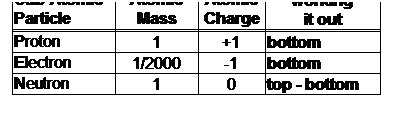
Protons, electrons and neutrons
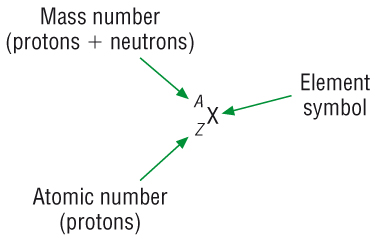
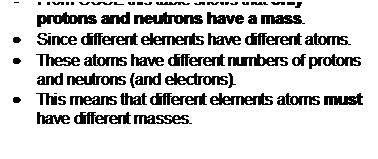
· So an atom of one element must have a different mass from another element, we call this the Mass Number.
· The number of protons determines which element an atom is and the bottom number tell us this, we call this the Atomic number.
Examples:-
1) Lithium
| 7 | Li |
| 3 |
Protons = 3
Electrons = 3
Neutrons = 4 (7-3)
2) Nitrogen
| 14 | N |
| 7 |
Protons = 7
Electrons = 7
Neutrons = 7 (14-7)
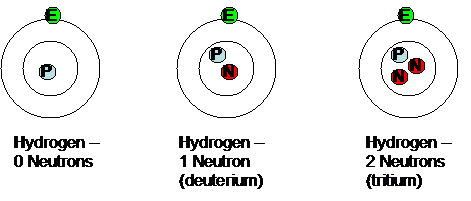
Isotopes
An atom of the same element that has the same number of protons and electrons but a different number of neutrons.
Atomic structure of ions
When an atom becomes an ion it must have gained or lost electrons.
This will have an effect on its atomic structure:
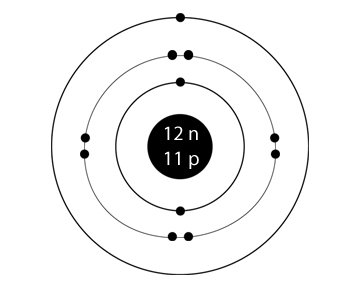
Sodium ion
The sodium ion has one less electron than its number of protons therefore the charge is 1+ (as electrons are negative)
 |
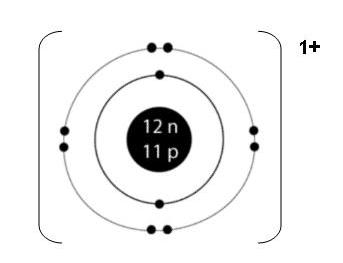 |
| Mass number, A = 23 | Mass number, A = 23 |
| Atomic number, Z, P = 11 (+) | Atomic number, Z, P = 11 (+) |
| Electrons, e = 11 (-) | Electrons, e = 10 (-) |
| Neutrons, N = 12 | Neutrons, N = 12 |
| charge is neutral, 11P (+) = 11e (-) | charge is 1+, 11P (+) = 10e (-) |
Chloride ion:
The chloride ion has one more electron than its number of protons therefore the charge is 1- (as electrons are negative)
 |
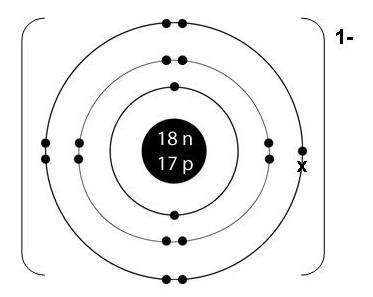 |
| Mass number, A = 35 | Mass number, A = 35 |
| Atomic number, Z, P = 17 (+) | Atomic number, Z, P = 17 (+) |
| Electrons, e = 17 (-) | Electrons, e = 18 (-) |
| Neutrons, N = 18 | Neutrons, N = 18 |
| charge is neutral, 17P (+) = 17e (-) | charge is 1-, 17P (+) = 18e (-) |
Questions 1, 2 p7 / 1 p35 / 1p36
· The first part of this is to be able to write formulae.
· Some names are straightforward whereas others are unexpected.
Writing formula
· A formulae is a shorthand way of describing a chemical substance.
· The composition and elements present are represented in the chemical formulae.
· Following a set of rules the chemical formula for a substance can deduced:-
|
Periodic Table Group |
Charge on ion |
Other ions |
|
1 |
1+ |
H+
NH4+ Ag+ |
|
2 |
2+ |
Co2+
Cu2+ Fe2+ |
|
3 |
3+ |
Fe3+ |
|
6 |
2- |
SO42-
CO32- |
|
7 |
1- |
|
· The ions in a chemical formula must add up to zero.
· Use subscripts after an ion in a formula to double/triple that ion so the sum=0. eg. CuCl2
· If you are double/tripling ions that consist of more than one element brackets must be used. eg. Ca(OH)2
· If Roman numeral numbers follow a metal ion in brackets, that tells you the positive charge of that metal ion. They are usually Transition Metals as they can have more than one oxidation state. eg. Copper (II) Chloride. Copper can also exist as copper (I).
· Water of crystallization can be added to compounds after a dot. eg. CuSO4.7H2O
How to work out formulae
Sodium Chloride - Na+ Cl- Write the ions with charges
1 : 1 Write the ratio of the charges
Scale up if necessary to =0
NaCl Bring together omitting the charges
Copper (II) Chloride Cu2+ Cl- Write the ions with charges
2 : 1 Write the ratio of the charges
Cu2+ : Cl-2 Scale up if necessary to =0
CuCl2 Bring together omitting the charges
Calcium Hydroxide Ca2+ OH- Write the ions with charges
2 : 1 Write the ratio of the charges
Ca2+ : (OH-)2 Scale up if necessary to =0
Ca(OH)2 Bring together omitting the charges
 Writing
simple formula from the periodic table
Writing
simple formula from the periodic table
Writing
complex formula
Balancing equations
One of the most important concepts in chemistry is that mass is always conserved.
You always have exactly the same at the end as what you started.
If you follow 4 steps – you cant go wrong:-
Step 1 Write out the word equation.
Iron + Hydrochloric acid à Iron (II) chloride + Hydrogen
Step 2 Write the correct formula underneath.
Iron + Hydrochloric acid à Iron (II) chloride + Hydrogen
Fe + HCl à FeCl2 + H2
Step 3 Balance using large numbers to scale up the number of molecules. A rule of thumb to help you balance is to balance the elements in this order - MACHO:
Metal
Any other element
Carbon
Hydrogen
Oxygen
A table helps.
Iron + Hydrochloric acid à Iron (II) chloride + Hydrogen
Fe + 2HCl à FeCl2 + H2

Put the 2 before the molecule with the element you are scaling up. You now have the same number of atoms on each side.
Step 4 All that remains is to add the state symbols.
Iron + Hydrochloric acid à Iron (II) chloride + Hydrogen
Fe + 2HCl à FeCl2 + H2

Fe(s) + 2HCl(aq) à FeCl2(aq) + H2(g)
You now have a balanced chemical equation. This can be used to record an experiment or calculate amounts to mix.
Questions 1-2 p19 / 11 p35
HCl(g) à H+(aq) + Cl-(aq)
Acids can be defined as proton donors
CH3COOH(l) + aq D H+(aq) + CH3COO-(aq)
Bases
Bases can be defined as proton acceptors
Alkalis
NaOH(s) + aq à Na+(aq) + OH-(aq)
Alkalis dissociate to give hydroxide ions in solution
NH3(g) + H2O(l) D NH4+(aq) + OH-(aq)
Biological acids and bases
Acids: fatty acids, amino acids, nucleic acids
Amphoteric: This means they have acidic and basic properties - amino acids - NH2 and CO2H
Questions 1-2 p23 / 12 p35
 (investigative)
(Acid / Base - done earlier with moles)
(NOTE: Alternatively do the practical as a circus cf GCSE)
All salts contain the following:
A positive cation - usually a metal or ammonium (NH4+)
A negative anion derived from an acid:
| Acid | Cation...Salt |
| Sulphuric | ...sulphate |
| H2SO4 | ...SO42- |
| Nitric | ...nitrate |
| HNO3 | ...NO3- |
| Hydrochloric | ...chloride |
| HCl | ...Cl- |
These salts are formed with one of the following reactions:
1 Metal + Acid à Salt + Hydrogen
2 Metal Oxide + Acid à Salt + Water
3 Metal Hydroxide (alkali) + Acid à Salt + Water
4 Metal Carbonate + Acid à Salt + Water + Carbon dioxide
Constructing balanced chemical equations:
Given 2 reactants it is possible to construct balanced chemical equations:
Example: Sodium hydroxide reacts with sulphuric acid, write a balanced chemical equation for this reaction:
Step 1 Use the 4 reactions above to identify your reaction - Sodium hydroxide tells us it is reaction (3)
Sodium hydroxide + Sulphuric acid à Salt + Water
Step 2 Work out the name of your salt:
Sodium hydroxide + Sulphuric acid à Sodium sulphate + Water
Step 3 Write the correct formula underneath.
Sodium hydroxide + Sulphuric acid à Sodium sulphate + Water
NaOH + H2SO4 à Na2SO4 + H2O
Step 4 Balance the equation, in this order - works 90% of the time
Metal
Any other element
Carbon
Hydrogen
Oxygen
Sodium hydroxide + Sulphuric acid à Sodium sulphate + Water
2NaOH + H2SO4 à Na2SO4 + H2O
| Element | Balanced | ||
| Na | 1 | 2 | NO |
| S | |||
| H | |||
| O |
Sodium hydroxide + Sulphuric acid à Sodium sulphate + Water
2NaOH + H2SO4 à Na2SO4 + 2H2O
| Element | Balanced | ||
| Na | 1 x 2 = 2 | 2 | Yes |
| S | 1 | 1 | Yes |
| H | 4 | 2 | NO |
| O |
Sodium hydroxide + Sulphuric acid à Sodium sulphate + Water
2NaOH + H2SO4 à Na2SO4 + 2H2O
| Element | Balanced | ||
| Na | 1 x 2 = 2 | 2 | Yes |
| S | 1 | 1 | Yes |
| H | 4 | 2 | No |
| O |
Sodium hydroxide + Sulphuric acid à Sodium sulphate + Water
2NaOH + H2SO4 à Na2SO4 + 2H2O
| Element | Balanced | ||
| Na | 1 x 2 = 2 | 2 | Yes |
| S | 1 | 1 | Yes |
| H | 4 | 2 x 2 = 4 | Yes |
| O | 6 | 6 | Yes |
Step 4 Add the state symbols:
2NaOH(aq) + H2SO4(aq) à Na2SO4(aq) + 2H2O(l)
You now have a balanced chemical equation.

Acid salts:
Sulphuric acid has 2 H+ ions, we call these diprotic acids as they can both be replaced:
H2SO4 à NaHSO4 Sodium hydrogen sulphate
NaHSO4 is known as an acid salt as it can donate another proton:
NaHSO4 à Na2SO4 Sodium sulphate
Ammonium salts and fertilisers
All fertilisers contain Nitrogen in the form of ammonium, NH4+ and / or Nitrate, NO3-.
Ammonium salts are formed when acids react with ammonia, NH3:
NH3(aq) + HNO3(aq) à NH4NO3(aq)
Calculating the % of N in a fertiliser:
As it is the N element that is important, we need to be able to calculate the % of that element in the compound.
Use this formula to calculate the %:
% Element = No of atoms of that element in the formula x Ar of the element x 100
Mr of the compound
Worked example:
Calculate the % of N in ammonium nitrate, NH4NO3:
1) Write out the formula:
% Element = No of atoms of that element in the formula x Ar of the element x 100
Mr of the compound
2) Calculate the Mr of the compound:
| Element | Ar | No that element | Sub total |
| N | 14 | 2 | 28 |
| H | 1 | 4 | 4 |
| O | 16 | 3 | 48 |
|
Mr = |
80 | ||
3) Fill in the rest of the formula and calculate the answer
% Element = 2 (N) x 14 (Ar) x 100
80
% Element = 35%
Questions 1-2 p25 / 13 p35
It is used to describe the number of electrons used to bond with another atom.
It is also used for combining powers of atoms.
It is a type of ‘book keeping’ for electrons.
It is a number describing the movement of electrons and is found by the application of certain rules:-
Rules for assigning Oxidation Numbers
1) Ox. No. of an element = 0
2) Ox. No. of each atom in a compound counts separately. Sum = 0
3) Ox. No. of an ionic element = charge on ion.
4) In a polyatomic ion (SO42-), The sum of the Ox. No.’s of the atoms = charge on ion.
5) H = +1 except with metals (metal hydrides = -1).
6) Gp 7 (Halogens) = -1 (except with oxygen)
7) O = -2 except in peroxides (H2O2, O = -1)
Examples:
Compounds -
CO2 O = - 2 each, total = - 4
The molecule is neutral so C + - 4 = 0
C = + 4
Formula -
MgCl2 Mg = + 2
Cl = - 1 each, total = - 2
Molecular ions -
NO3- O = - 2 each, total = - 6
The molecule = - 1 so N + - 6 = -1
N = + 5
Oxidation numbers in chemical names:
Some elements form compounds where they could have a different charge / oxidation number.
You will already be familiar with the Transition metals for this from GCSE:
Transition metals:
| Compound | Name | Element with different Ox. No. | Ox. No. of that element |
| FeCl2 | Iron (II) chloride | Fe | +2 |
| FeCl3 | Iron (III) chloride | Fe | +3 |
Roman numerals indicate the oxidation number of the element before it.
This also occurs with oxyanions:
Oxyanions:
| Oxyanion | Name | Element with different Ox. No. | Ox. No. of that element |
| NO2- | Nitrate (III) | N | +3 |
| NO3- | Nitrate (V) | N | +5 |
These are negative molecules that contain an oxygen atom.
Oxyanions usually end in 'ate' to indicate the presence of oxygen.

Questions 1-4 p31 / 14 p35
Our understanding of oxidation and reduction was limited to reactions involving oxygen and hydrogen:
2Mg(s) + O2(g) à 2MgO(s)
Magnesium has been oxidised as it has gained oxygen.
But it has also lost 2 electrons:
Mg(s) - 2e- à Mg2+(s)
Oxygen has been reduced as it has lost oxygen.
But each oxygen has also gained 2 electrons:
O2(g) + 4e- à 2O2-(s)
A new definition could be used involving electrons and this could be applied to all reactions:
Oxidation - is addition of oxygen / loss of hydrogen /
Is
Loss of electrons
Reduction - loss of oxygen / addition of hydrogen /
Is
Gain of electrons
Oxidation and reduction must occur simultaneously as all reactions involve a movement of electrons.
These reactions are given the shorthand term of REDOX reactions. As they involve
REDuction and OXidation
Redox reactions can now be applied to reaction that do not involve oxygen or hydrogen:
2Fe(s) + 3Cl2(g) à 2FeCl3(s)
Looking at each species often makes it easier to decide which has been oxidised and reduced.
Adding the oxidation number makes it even easier:
2Fe(s) + 3Cl2(g) à 2FeCl3(s)
Fe(s) à Fe3+(s) + 3e-
0 +3
To go from 0 to +3 means electrons have been lost = Oxidation - increases Ox No's
1/2Cl2(g) + e- à Cl -(s)
0 -1
To go from 0 to -1 means that electrons have been gained = Reduction - reduces Ox No's
Oxidising and reducing agents:
2Fe(s) + 3Cl2(g) à 2FeCl3(s)
Fe(s) à Fe3+(s) + 3e- Oxidation
0 +3
1/2Cl2(g) + 2e- à Cl -(s) Reduction
0 -1
As chlorine accepted the electrons from iron for it to be oxidised we say that chlorine is the oxidising agent
As iron gave the electrons to chlorine for it to be reduced we say that iron is the reducing agent:
Oxidation Reducing agent
Is
Loss of electrons
Reduction Oxidising agent
Is
Gain of electrons
Examples of oxidising and reducing agents
Iron ions can exist as Fe2+ and Fe3+:
Fe2+ solutions are green and Fe3+ solutions are brown.
Fe2+ à Fe3+ + e- Oxidation (requires an oxidising agent)
Green Brown
And:
Fe3+ + e- à Fe2+ Reduction (requires a reducing agent)
Brown Green
Using oxidation numbers with equations:
When assigning oxidation numbers to elements it is a good idea to set it out as below:
| Mg(s) | + | 2HCl(aq) | à | MgCl2(aq) | + | H2(g) |
| Mg(s) | + | 2HCl(aq) | à | MgCl2(aq) | + | H2(g) | |||
| Ox No's | 0 | +1 | -1 | +2 | -1 | 0 | |||
 |
|||||||||
| 0 à+2 | +1à 0 | (x2) | |||||||
| Up 2 | Down 2 | ||||||||
Things to note:
| Mg(s) | + | 2H+(aq) | à | Mg2+ (aq) | + | H2(g) |

Qu 1-2 p33 / Qu 1, 11, 12, 13, 14, 18 P35 / Qu 1, 2a, 5a, 6a, 6b P36, 37